
May 05, 2026
USTR Hearing on Section 301 Investigations into Structural Excess Capacity
Thank you for the opportunity to provide testimony today. My comments will focus on the strategic challenge presented by China and its structural excess capacity and other unfair trade practices that unfairly burden or restrict U.S. commerce.
My comments draw from research I have conducted at the Center for a New American Security, an independent, bipartisan think tank working on national security issues, as well as my prior government service.
I. Framing the Problem
Let me start by making three overarching points, which I will follow with a proposal for actions that the Office of the U.S. Trade Representative (USTR) could pursue as a remedy under the Section 301 process.
First, excess capacity from China is categorically different than that from other sources.
The structural imbalance of China’s economy is a well-documented and long-standing concern for the United States and other advanced economies.
State support for strategic sectors, unfair trade practices, and an unwillingness to undertake difficult reforms to reorient the Chinese economy toward more consumption-driven growth have all contributed to conditions today in which Chinese manufacturing exports undermine the ability of other countries to strengthen their own domestic industrial capacities.
China’s state-supported trade imbalances have strategic implications, in addition to economic impacts, given China’s increasing technological capabilities, as well as its demonstrated willingness to use its market power to economically coerce other countries, including the United States.
These strategic factors are fundamentally different than what exists with other major trading partners with whom the United States has a goods trade deficit. Imbalances with close partners and security allies may, under certain circumstances, present discrete burdens or restrictions on U.S. commerce but do not directly and broadly threaten U.S. economic and national security interests in the way that Chinese control over critical goods does.
Second, an increasing Chinese share of global markets for critical goods is a strategic problem, whether or not it arises from structural excess capacity.
To give one concrete example, we can look to foundational semiconductors. China’s utilization rates are on par with industry standards, yet China’s share of global fabrication capacity has doubled in recent years and accounts for over half of planned production expansion globally. China’s growing dominance in foundational semiconductors may restrict the U.S. ability to procure chips from a diverse range of trusted suppliers. This undermines U.S. economic and security interests, regardless of whether Chinese policies have led to excess capacity as defined in the notice.
Third, unilateral approaches to structural excess capacity will push that capacity elsewhere but are unlikely to resolve the underlying causes.
The U.S. trade deficit with China in 2025 was the lowest recorded since China joined the World Trade Organization. At the same time, China’s trade surplus with the world hit record highs.
Rather than creating meaningful incentives for China to change its policies, U.S. tariffs succeeded primarily in pushing the burden of China’s excess capacity to other markets.
The result is that domestic U.S. producers may enjoy protection from Chinese imports while selling within the U.S. market, but they will remain substantially disadvantaged when trying to export to third-party markets in which Chinese imports flow unimpeded. The administration’s admirable goal of rebuilding U.S. manufacturing cannot succeed without a policy that facilitates U.S. manufacturing exports and directly addresses the impact of excess Chinese capacity in third-party markets.
II. U.S. Actions to Resolve Concerns
With these framing points in mind, let me turn to a proposed policy solution that can be pursued under the Section 301 authorities.
If one accepts that China’s excess capacity is categorically different and strategically consequential, and that unilateral responses are inadequate, it is clear that a coordinated approach with U.S. allies is the path forward. Rules-based, binding plurilateral agreements with close partners can build the scale necessary to support commercially viable alternatives to markets that are heavily distorted by China.
The administration’s ongoing work to negotiate a plurilateral agreement on critical minerals is an excellent example of the type of arrangement that could be negotiated as a response to Chinese excess capacity in other sectors, including semiconductors, pharmaceuticals, electric vehicles, and steel and aluminum.
The main goal of plurilateral agreements in strategic sectors should be to align policies that can build demand for critical goods not produced in China, including policies related to government procurement, supply chain security restrictions, and tariffs.
A plurilateral approach will only work if it builds sufficient scale to provide an alternative to China. To build this scale, there must be meaningful incentives for other major consumer nations to participate. Fundamentally, this will mean low or no U.S. tariffs on critical goods imported from countries participating in the agreement, so long as there is alignment on common standards and tariffs for imports from outside of the agreement and specifically from China.
Additional details related to the plurilateral agreement concept are provided in public comments that I and my colleague Geoff Gertz submitted.
Thank you for the opportunity to provide comment today.
Download the Statement
More from CNAS
-
Public Comments Submitted in Response to USTR Initiation of Section 301 Investigations
 Commentary
Executive Summary In its request for comment, the Office of the U.S. Trade Representative (USTR) solicits comments on and recommendations “regarding the acts, policies, and p...
By Emily Kilcrease & Geoffrey Gertz
-
Commentary
Energy, Economics & Security / Technology & National Security
Recommendations for Promoting American AI AbroadStrategic Context and Program Objectives The American AI Exports Program is an ambitious and essential proposal to expand the reach of American AI technologies in foreign mar...
By Janet Egan, Geoffrey Gertz, Daniel Remler & Ruby Scanlon
-
Game Over?
Reports
The trade wargame suggests that sustained high tariffs could create leverage and urgency to spur action toward a productive restructuring of the international trade system....
By Emily Kilcrease & Geoffrey Gertz


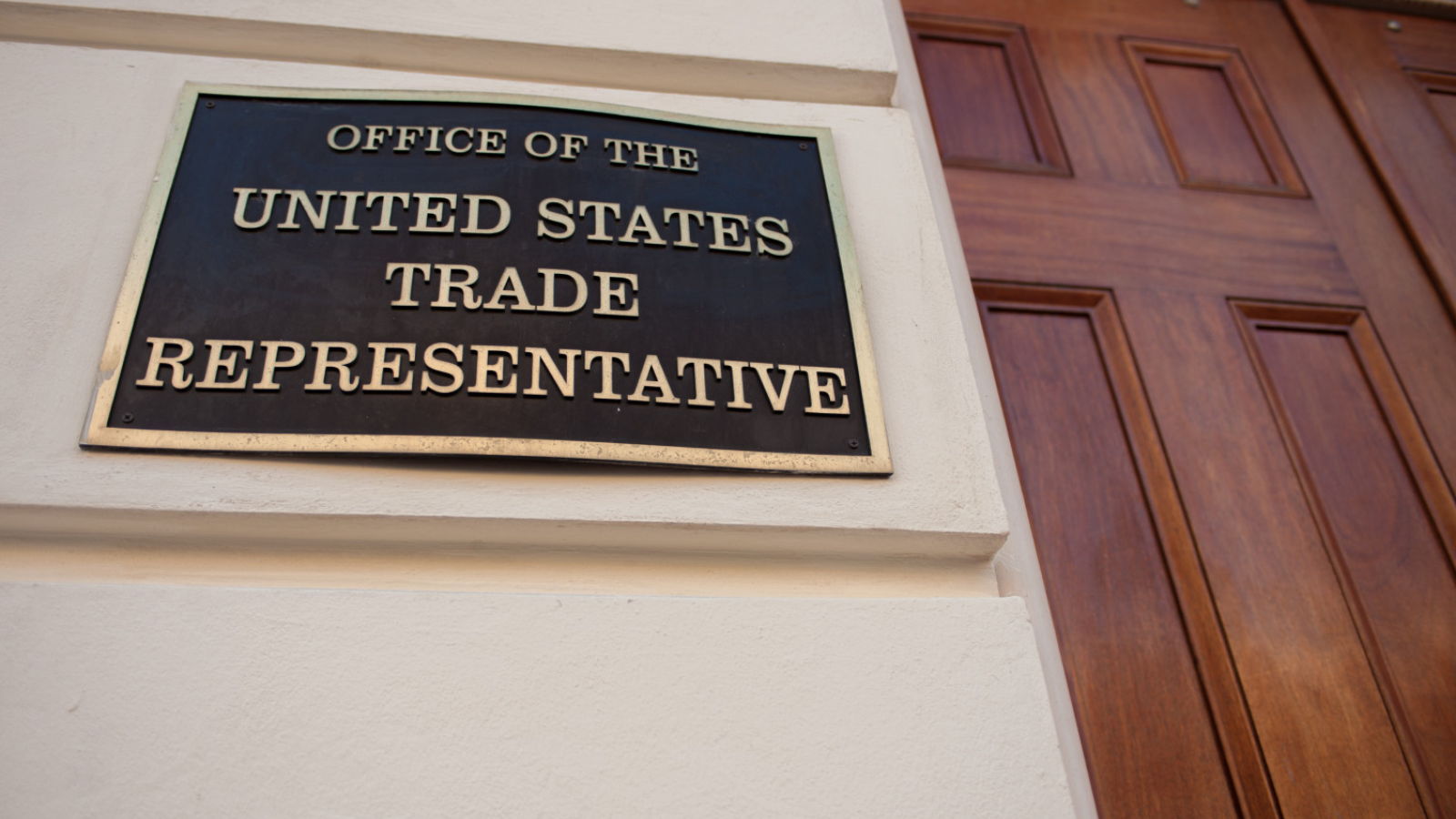
On May 5, 2026 Emily Kilcrease, Senior Fellow and Director of the Energy, Economics, and Security Program at CNAS testified at the Office of the United States Trade Representative regarding the Section 301 investigations into 16 economies acts, policies, and practices relating to structural excess capacity and production in manufacturing sectors. Below is her opening statement.