
June 05, 2026
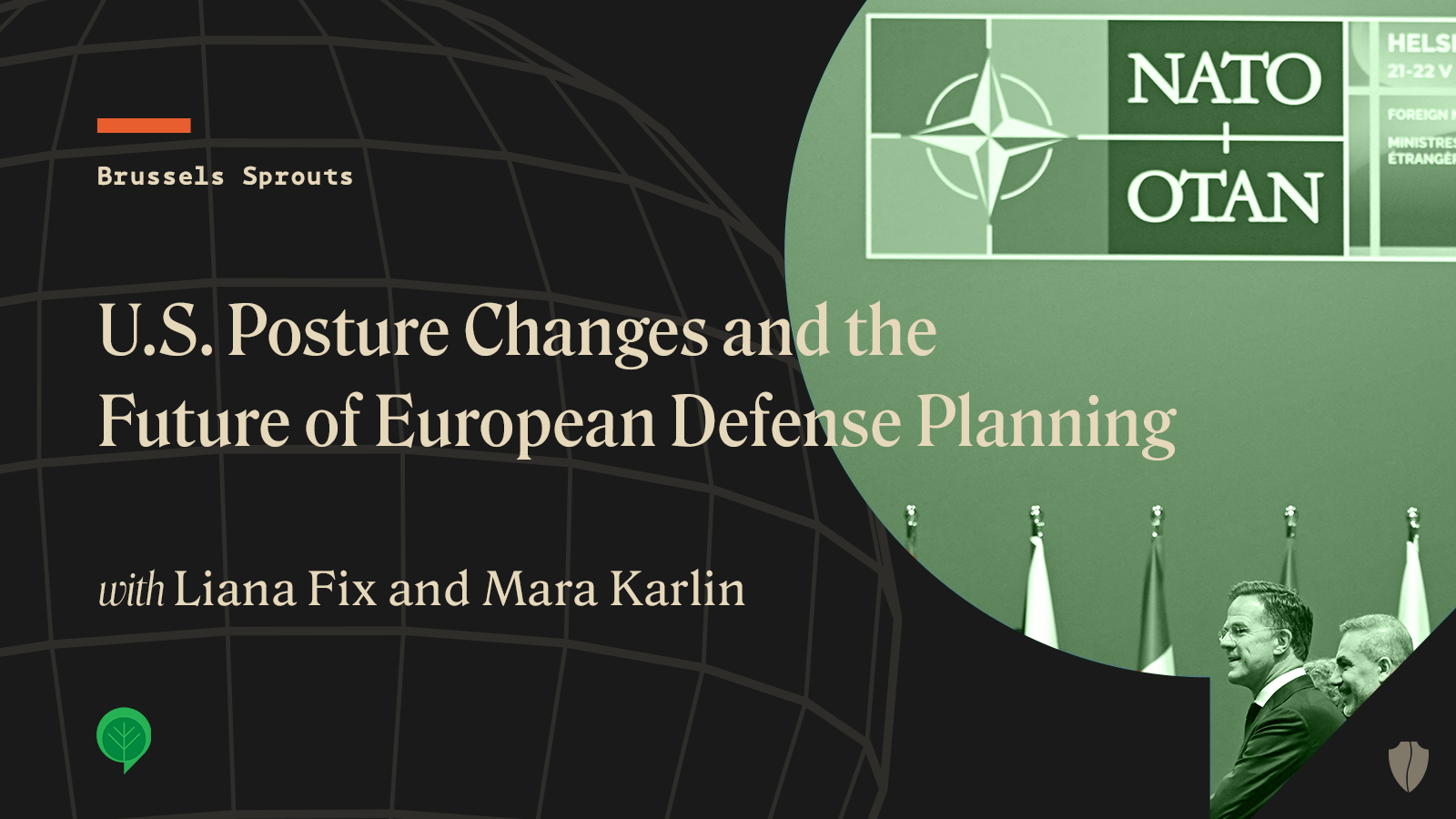
U.S. Posture Changes and the Future of European Defense Planning
Over the last several weeks, European allies have been trying to interpret a steady stream of signals from Washington about the future of the U.S. military role in Europe, discussions we've covered on the last two episodes of Brussels Sprouts. Beyond the headlines about troop levels, the broader concern is that the United States may be preparing to scale back some of the critical capabilities that have long formed the backbone of NATO’s deterrence posture, including the forces and enablers needed to rapidly reinforce Europe in a crisis. The uncertainty has exposed deeper questions about how decisions on U.S. force posture are made, how allies should prepare for a potentially smaller American role, and whether Europe is moving fast enough to adapt to a more demanding security environment. These debates are particularly acute in Germany, where questions about deterrence, defense spending, and Europe’s long-term security architecture are increasingly central to the political conversation.
To help us dig into these issues and what they all mean for the future of transatlantic security, we’re very happy to welcome Mara Karlin and Liana Fix to this week’s edition of Brussels Sprouts.
Liana Fix is a senior fellow for Europe at the Council on Foreign Relations.
Mara Karlin is a visiting fellow at the Brookings Institution and a professor of practice at Johns Hopkins University’s School of Advanced International Studies.
More from CNAS
-
A Report Card for Europe’s Defense Industry
 Podcast
As the war in Ukraine rages on, Ukraine has struggled this summer with a munitions shortage. With U.S. supplies strained by the war with Iran, European governments are having ...
By Andrea Kendall-Taylor & Jim Townsend
-
Sep 04, ’26 Washington Roundtable
Podcast
Jim Townsend, an adjunct senior fellow at the Center for a New American Security, joins the Defense & Aerospace Report Podcast to discuss the latest on the Iran War, Russi...
By Jim Townsend
-
Putin Says Ukraine Peace Deal Is Possible: Is This a New Path to Peace?
Video
Jim Townsend, an adjunct senior fellow at the Center for a New American Security, joins Al Arabiya English to discuss Russian president Vladimir Putin's comments on reaching a...
By Jim Townsend
-
A Surprise Moscow Visit and Russia vs. the West with Hanna Notte
Podcast
Central Intelligence Agency Director John Ratcliffe made a highly unusual visit to Moscow this week. Although we don’t know with certainty everything that was discussed, multi...
By Andrea Kendall-Taylor & Jim Townsend


