
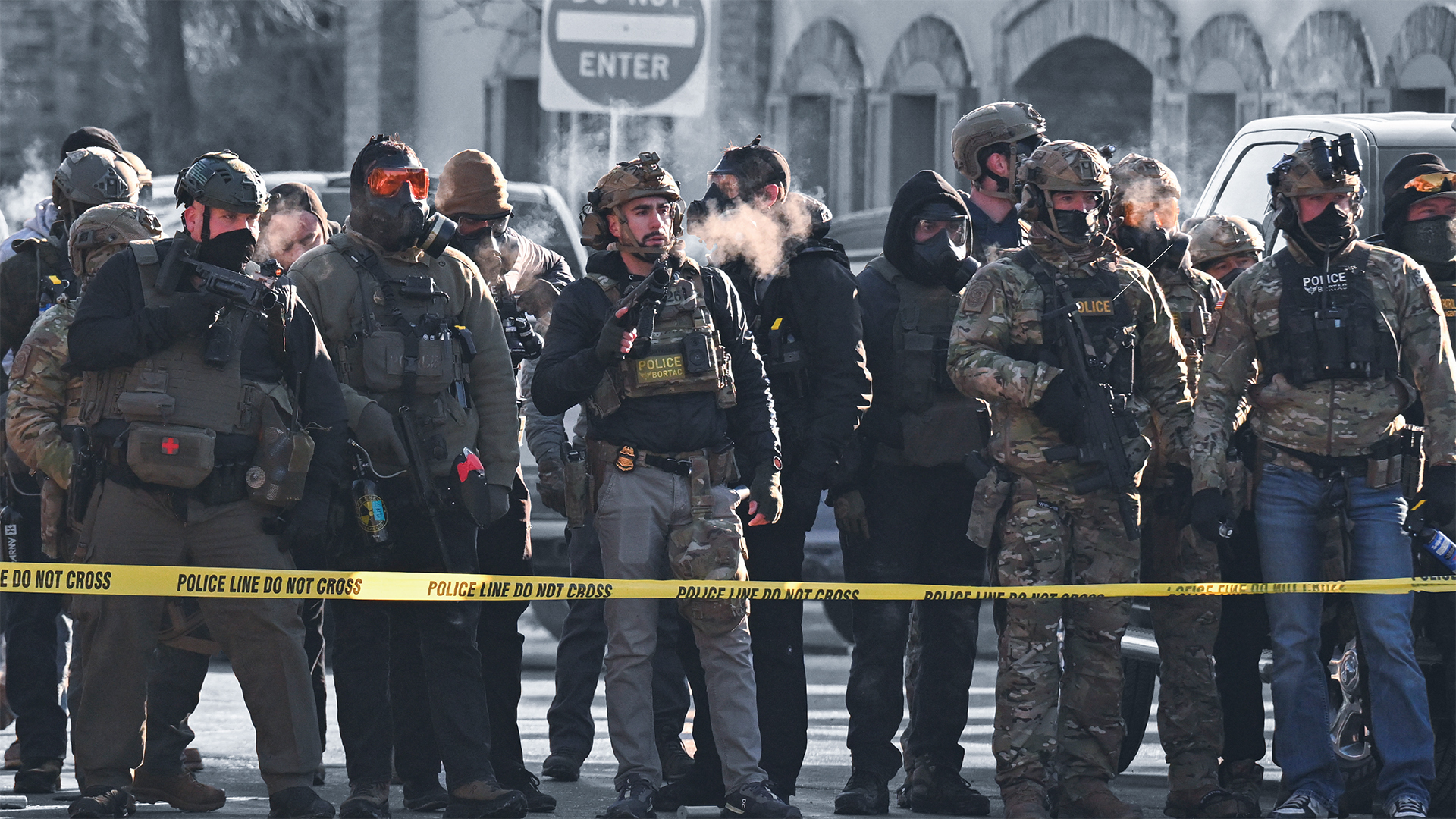
Geared Up: Legal & Policy Considerations for Military and Law Enforcement Uniforms
Building on its prior work on issues at the intersection of federalism, national security, domestic deployment, and law enforcement activities, the Center for a New American Security (CNAS) National Security Law Program is publishing a commentary series that assesses the legal and policy considerations for improving the framework governing law enforcement use of military uniforms and gear. Expert authors assess the legal frameworks for how military uniforms make their way into the law enforcement ranks, analyze the rules that apply to civilians who may wear surplus military gear, and consider what a militarized law enforcement presence means from the policing perspective. Authors provide recommendations for federal or state actions that could clarify the rules governing how law enforcement professionals appear. The series also includes a legal backgrounder on military and law enforcement powers and differing lines of authority.
In February 2024, CNAS launched a project on federalism and national security. Under that project, CNAS published a commentary series in spring 2025, The 21st Century National Guard: Expanding Missions, Modernizing Authorities, which explored current trends and dynamics in the modern uses and authorities of the National Guard. Expert authors analyzed how the Guard has been used and will be increasingly called upon in years ahead. They provided recommendations for modernizing and clarifying legal authorities for National Guard deployment and for legislative action at the state and federal levels. The December 2024 report Stress Testing State Power: When Governors and Presidents Diverge on Matters of National Security was also published under this research project and previewed litigation (which has since taken place) over the deployment of the National Guard.
The CNAS project on federalism and national security was initiated with support from the Democracy Innovation Fund, Defending Democracy Together Institute. Continued work on domestic deployment and related issues has been made possible by support from the William and Flora Hewlett Foundation.
As a research and policy institution committed to the highest standards of organizational, intellectual, and personal integrity, CNAS maintains strict intellectual independence and sole editorial direction and control over its ideas, projects, publications, events, and other research activities. CNAS does not take institutional positions on policy issues, and the content of CNAS publications reflects the views of their authors alone. In keeping with its mission and values, CNAS does not engage in lobbying activity and complies fully with all applicable federal, state, and local laws. CNAS will not engage in any representational activities or advocacy on behalf of any entities or interests and, to the extent that the Center accepts funding from non-U.S. sources, its activities will be limited to bona fide scholastic, academic, and research-related activities, consistent with applicable federal law. The Center publicly acknowledges on its website annually all donors who contribute.
Explore the Series
 Commentary
An Achievable Balance
Terrence M. Cunningham is the deputy executive director and chief operating officer of the IACP. Gene Voegtlin is the director of policy, research, and public affairs at the I...
 Commentary
Legal Background: Distinguishing Between Law Enforcement Powers
Matthew Kroscher is a second-year law student at George Mason University’s Antonin Scalia Law School and was a spring 2026 CNAS legal intern....
 Commentary
Modernize States’ Legislative Efforts on Unsanctioned Militias While Protecting Constitutional Rights
Matt Gimovsky is senior corporate counsel at Kroll and an Army JAG with active-duty experience in administrative law and with the trial defense service....
 Commentary
Blurring the Line
Mark Nevitt is currently an associate professor of law at Emory University School of Law and a CNAS adjunct senior fellow....
 Commentary
Masked and Anonymous
David Aaron is a former Manhattan assistant district attorney and Department of Justice national security and cyber prosecutor. He is now in private practice at an AmLaw 50 la...
 Commentary
Distinguishing Between Soldiers and Law Enforcement Officers
Carrie F. Cordero is the Robert M. Gates senior fellow and director of the National Security Law Program at CNAS....